


Ross Hall
From Colonial Mansion to Historic Treasure
One of the Metlar-Bodine House Museum's most extraordinary artifacts is the Ross Hall Wall—the only surviving piece of the historic Ross Hall estate, a site closely connected to General George Washington and the birth of an American tradition.
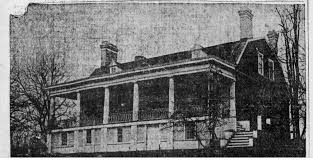 The Ross Hall house was a prominent structure in the colonial port community of Raritan Landing, Piscataway, NJ. In 1740 Edward Antilll built the imposing home along the banks of the Raritan River. Edward's wife Anna was the daughter of Governor Lewis Morris who served as Governor of New Jersey from 1738 until his death in 1746. Anna and Edward resided there until 1763 when it was sold to Dr. Alexander Ross. Ross passed away right before the Revolution, in 1775, and his wife, who was a patriot sympathizer during the war, offered her home to be command headquarters in July 1778.
America's First Fourth of July Celebration
Following the Battle of Monmouth, Washington and more than 11,000 Continental soldiers camped along the Raritan River in Piscataway. From his headquarters at Ross Hall, Washington issued an order that would establish a tradition still celebrated across the nation today.
On July 3, 1778, he directed his troops to commemorate the anniversary of American independence with cannon fire, a ceremonial military salute, and a double ration of rum. The following day, soldiers lined the banks of the Raritan River and participated in what is widely recognized as the first organized military celebration of Independence Day.
That evening, Washington hosted a grand gathering at Ross Hall attended by some of the most influential figures of the Revolutionary War, including Alexander Hamilton, the Marquis de Lafayette, and James McHenry.
The Fate of Ross Hall

Mrs. Ross eventually remarried - her second husband Charles Howard. In 1792 Miles Smith took possession of the home and it remained in the hands of the Smith family until 1880 when entrepreneur George Metlar became its owner. The New Brunswick Golf Club leased property in Piscataway from Metlar. and used the historic 18th-century Ross Hall as their official clubhouse.
Rutgers University owned the house in the 1950’s, but after a fire, they decided to have it destroyed. Dr. Richard P. McCormick, well known Rutgers history professor, insisted that a piece of the building, its fully paneled parlor wall, be saved. It was exhibited at the New Jersey Historical Society until it was given to the Township and the Metlar-Bodine House in 2000.
A Vision for the Future
Today, the Ross Hall Wall remains carefully preserved while plans move forward for its restoration and public display in a dedicated educational wing at the Metlar-Bodine House Museum. This future exhibit will allow visitors to experience an authentic piece of Revolutionary-era history and learn about the events of July 1778 that helped establish America's Independence Day tradition.
The Ross Hall Wall is a magnificent survivor of the importance of high-style design to the early occupants of the area. It confirms the presence of builders and craftspeople in Central New Jersey, who had the skills to design and construct fine examples of architectural cabinetry furniture. This fact, and the Ross Hall Wall's provenance, dating to the Revolutionary War event described above, truly makes it an American Treasure.
In Fiscal Year 2023, Congressman Frank Pallone, Jr. (NJ-06) secured $500,000 in federal funding toward constructing the brand new gallery designed to house the historic Ross Hall Wall.